
Maximum Diversity and Routing Efficiency

The TNS SS7 network infrastructure provides signaling for call routing and access to intelligent services for all service providers. Our network is designed for maximum diversity and routing efficiency. With our service bureau approach, TNS helps you reduce the complex and expensive engineering involved in managing your network operations. 

Image
phone network

ISUP and TCAP Defined

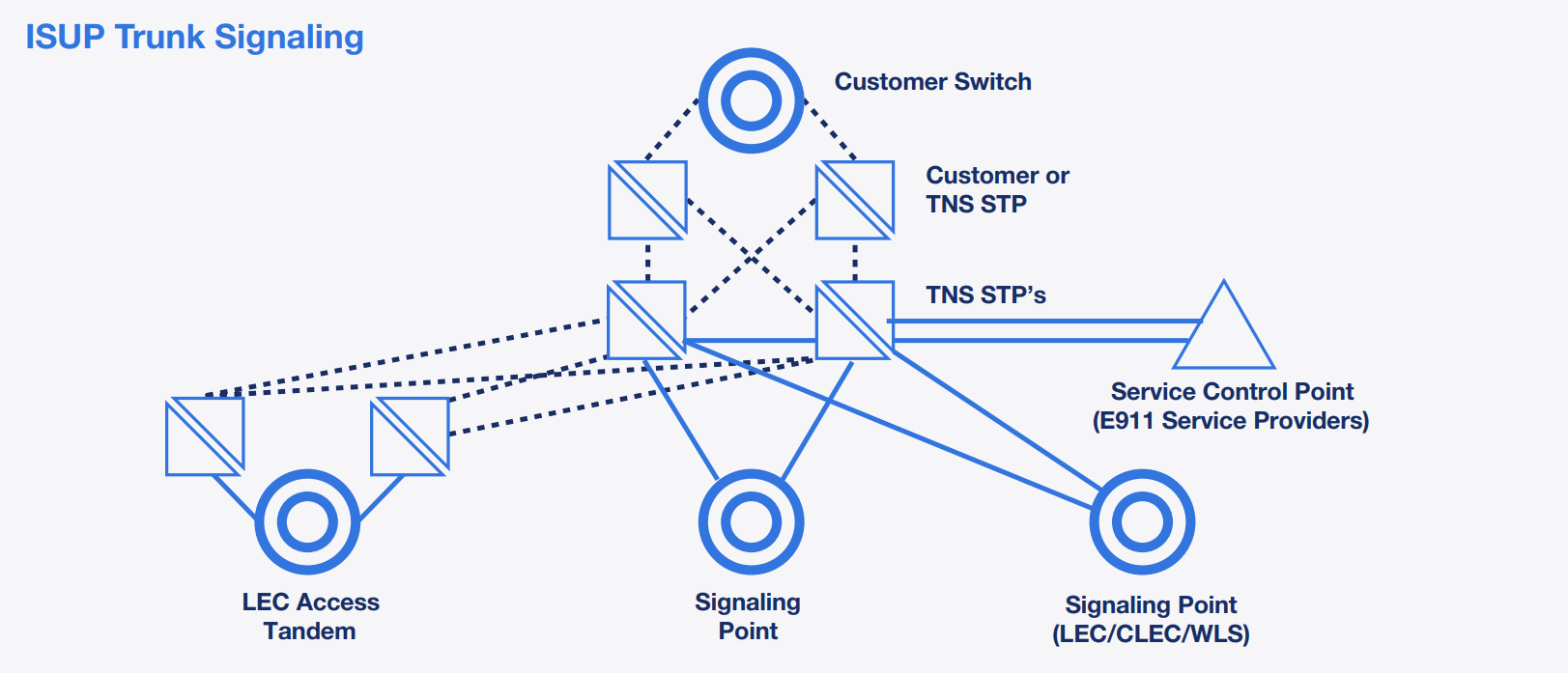
TNS ISUP (ISDN User Part) Trunk Signaling allows you to deliver virtually instant connections for your customers and to deploy a full range of intelligent network services. ISUP Trunk Signaling replaces in-band signaling, so information for call setup and teardown is carried on out-of-band data links using the ISUP layer of the SS7 protocol. ISUP service is critical to call processing, therefore TNS has employed an ILEC access strategy using only the TNS network. This minimizes the number of hops in the message path and results in more efficient routing, troubleshooting and network management. TNS ISUP Trunk Signaling provides direct access to all Regional Bell Operating Companies (RBOCs) and to all major ILECs, streamlining your SS7 operations by dealing with one dependable point of interconnection. 

In addition, the same signaling path used for ISUP can be used to facilitate inter-office CLASS (Custom Local Area Signaling Services). Through switch to switch signaling, TNS TCAP CLASS Messaging enables competitive services such as automatic call-back and automatic recall. TNS support of the *66 and *69 CLASS functions includes full Global Title support and LNP treatment to deliver these TCAP CLASS messages to all of your signaling partners, including RBOCs Operating companies and major independent networks.

How ISUP & TCAP Can Help

Image
ISUP Trunk
  • TNS ISUP - Service performs out-of-band call set-up and teardown and uses the same signaling path to facilitate inter-office CLASS services
  • TCAP CLASS - Messaging enables you to offer competitive services such as automatic call back and recall
  • Access - With one connection to TNS, the largest independent signaling network, you have direct access to more carriers than any other hub provider
  • SS7 links - All SS7 links including ILEC LATA connections, are monitored real time 24/7
  • Monitor - In-house engineering tools monitor and control link utilizations; trending is used to identify the need for link augmentation.
  • Coverage and reliability - Enjoy greater link diversity, efficient routing, and direct access to all Regional Bell Operating Companies (RBOCs) and major Incumbent Local Exchange Carriers (ILECs) for Local Access and Transport Areas (LATAs) access utilizing only the TNS network. Our IP backbone handles large bursts of traffic for efficient service even during peak traffic.
  • Full solutions partner - We are a single-source access provider to a full range of intelligent network and database services designed to simplify management of your network operations. We facilitate evolution to next-generation services with support of IP protocols and standards, including SIGTRAN, SIP, and ENUM, as well as a full suite of carrier ENUM solutions.
  • Superior customer support - TNS will help you manage your network with customized network reporting, proactive monitoring of your network traffic 24/7, and notification of significant growth. Our dedicated, experienced design and implementation team will work with you to set up the most efficient network plan
Overview
Features
Benefits

ISUP Trunk Signaling Step-by-Step

  1. Call request is started from originating SSP or Mobile Switching Center (MSC) to the terminating SSP/MSC.
  2. An Initial Address Message (IAM) is sent from originating SSP/MSC and STP to the terminating STP and SSP. Originating SSP/MSC reserves a trunk between itself and the terminating SSP.
  3. If the called party is available, an Address Complete Message (ACM) is returned to the originating SSP/MSC. If not available, the terminating SSP responds with a busy tone and the call ends.
  4. SSP receives the Address Complete Message indicating availability and completed connection.
  5. When a party disconnects, the SSP or MSC serving the disconnecting party disconnects the voice circuit and sends a Release Message to the other SSP/MSC.
  6. The SSP/MSC receiving the Release Message acts on this information by releasing its own facility and subsequently transmits a Release Complete Message (RCM) to the SSP/MSC that initiated the first release.

Contact Us

Discover more about how TNS ISUP & TCAP can help grow your organization.

Communication Preference

Please select yes if you would like to receive the latest news from TNS.

By entering your personal information on this form and clicking on the “Submit” button, you are giving TNS permission to use the personal information you submit for the purposes set forth in our TNS Group Privacy Policy.